Indoor self storage.
The most space-efficient form of self storage: many small, temperature-controlled units across several levels, right in the city. And the most demanding to plan and operate.
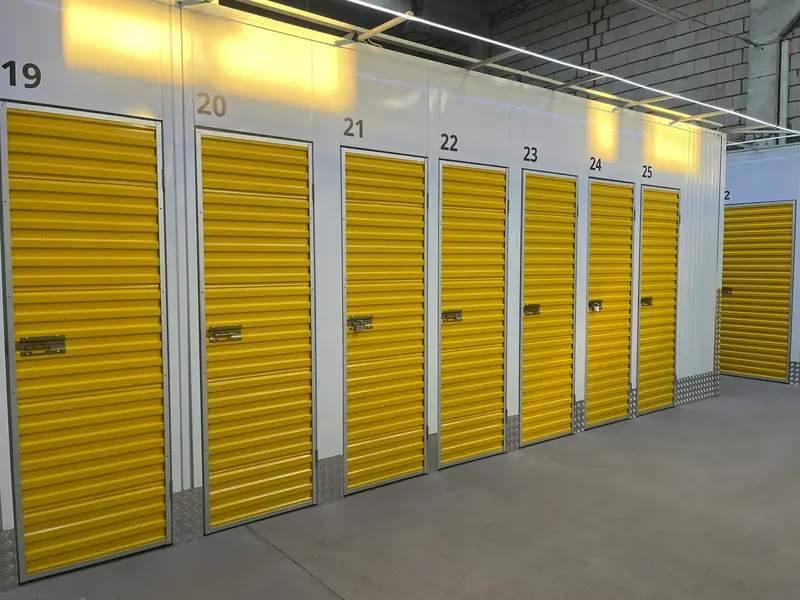
Indicative values, depending on the project.
Photo: Aga Adamek / Unsplash
The principle
In indoor self storage, a building is divided into many lockable units using a system of steel partition walls, doors or roller doors and, where ceiling height allows, additional mezzanine levels. Tenants reach their unit via corridors, goods lifts and trolleys, usually around the clock via app or PIN.
Because a large amount of lettable space is created per square metre of land, the model also works where land is expensive. That is exactly where demand is highest.
Conversion vs. new build
Conversion
Vacant DIY stores, supermarkets, warehouses or office buildings are converted. Faster and often cheaper, but dependent on structural capacity, ceiling height, column grid and approval for the change of use.
New build
Tailor-made, energy-efficient and optimised for self storage. In return, higher investment, longer permitting and construction times and a more intensive site search.
Construction & technology
Partition and mezzanine systems
Specialist manufacturers supply modular steel systems with walls, doors, roller doors and steel platforms. The unit mix should be based on a demand analysis. Too many large units is a common mistake.
Fire safety
Large floor areas divided into many units with unknown contents are highly demanding: fire compartments, escape routes, smoke extraction, fire alarm systems and, where required, sprinklers. Bringing in a fire safety engineer early is essential.
Climate & energy
Indoor facilities are usually temperature-controlled and ventilated to prevent moisture. Good insulation, LED lighting with motion sensors and rooftop solar PV noticeably reduce operating costs.
Access & security
Access control via app or PIN, electronic locks on each unit, CCTV and an alarm system. Modern facilities run largely unstaffed.
Location requirements
- A dense catchment area with many rented flats within a few minutes' drive
- Visibility from a busy road: the building is the best advertisement
- Easy access and parking for vans
- Storage / commercial use permitted under planning law
- Limited direct competition in the core catchment area
Costs & feasibility
The investment comprises the land or property, conversion or new build, the partition system, technology and start-up costs. Because indoor facilities usually achieve the highest rents per square metre, they can be financially attractive despite the higher investment, provided occupancy and pricing develop as planned.
Who indoor suits
A good fit if …
- a dense urban location is available
- a suitable existing building is available
- you plan for the long term and have operator know-how
Less suitable if …
- you want to start quickly on a small budget
- plenty of low-cost open land is available
- you do not want to build up or buy in operations